Monthly Archives: June 2009

Product Review: Kettler Ergo Racer

kettler_ergoracer_gt_7988-900_350Before I get into my specific thoughts of the Kettler Ergo Racer, I figure I should explain my road that led purchasing it. First of all, I am not a fan of indoor riding or trainers. I have a pair of rollers and a magnetic trainer. Both are mild forms of torture to me, the trainer especially so. A couple of years ago though I was preparing for Ironman Arizona and would jump in a spin class when the weather was too cold. I didn’t really follow the instructor with all the activities, but enjoyed the spin bike because the heavy flywheel gave a more realistic ride, it was sturdy enough that I could really attack hills out of the saddle and it was much quieter than my trainer or rollers.

The fitness center also had a couple of stationary bikes that had a 3d graphic of the course you were riding complete with other riders and your previous best effort. Great application but the bike is very upright and not anything close to my riding position. With these two thoughts in my head I started looking for some kind of spin bike that had the ability to control the resistance and have a graphical interface. Well, long story short, the search took forever, but I found the Kettler Ergo Racer and pulled the trigger.

kettlerergo_racer_gt-f-200The bike itself is very sturdy, just like the spin bikes and it has a 40 pound flywheel, so the ride feels very realistic.

Although it looks a little strange in the picture, the Kettler design allows you to set it up just like your actual bike, aerobars and all. This was a concern of mine before I bought it as I wanted to be positioned just like I am on my triathlon bike. The only difference I noticed is that the aerobars are wider that what I have on my bike. Very minor and to me a non issue. The saddle is a standard saddle which I found comfortable, but if you prefer something else like Adamo, it’s an easy switch. It comes with pedals, but I never took them out of the package, opting instead for my Look Keo’s. The Handlebars are made of a heavy duty metal (same size as your bike handlebars, just much sturdier) and can be changed from a road ergo_racer_gt-e-200setup to triathlon bull-horn, or upside-down for a cruiser position. I found the bull-horn setup to be too deep, but am very happy in the road set up.

The resistance is controlled magnetically and unlike a spin bike has a freewheel, so you can coast. It’s also whisper quiet. No need to apologize to the neighbors about the noise or even turn up the TV, the only noise you will hear is a quiet hum. Very nice for someone who has two small children that I don’t want to wake.

The Kettler Ergo Racer comes with a computer console in which you can ride some preprogrammed workouts or do your own thing in the manual setting. For a quick workout, I think they work just fine. The console also shows your heart rate (it will pick up your Polar signal) speed, cadence, time, watts, distance, and calories burned. I will say that the speed/distance isn’t all that accurate, but that wasn’t a big issue for me as I had a fix for it.

kettler-ergoracergt2The only piece of this puzzle that was missing was the 3d simulation of the course you are riding. I really wanted this as it held my attention better than anything else I have tried. In my research I found that there is a product made by Fitcentric called Netathlon2. It allows you to ride courses (some famous) against yourself or others online and will work with dozens of bikes/trainers (I will review this soon). Underneath the console of the Kettler is a port that will allow you to hook into a computer. I got Netathlon2, plugged it into my Kettler and I am riding the Ironman Hawaii Course in 3D. Perfect!

Overall I am very pleased with my purchase. If I were going to complain about anything it would be the console and native technology that seems to be a bit outdated. If Kettler wanted to hit a home run they would stick a better chip, screen and software in the console to give more options out of the box. As I mentioned though, I rarely use the console as I bypass it by plugging it into my computer so as to get all the bells and whistles.

Posted in Biking, Gear | Tagged , , , | 5 Comments

The Two-Beat Kick

Back in February, I wrote about the importance of the kick and what you can do to improve it. (If you missed it here’s the link). Recently, I have been getting a number of questions about the frequncy and timing of the kick, and more specifically, the two beat kick.

Generally speaking, when someone starts swimming, they tend to have their head and shoulders riding very high in the water with the hips and legs dragging behind (poor balance). Poor rotation and a horrible streamline are also pretty standard. To compensate for this, the swimmer will kick a little harder to bring the hips up and to try and generate a little more propulsion. My experience is that this comes in the form of the 4 beat kick (2 kicks for every stroke). As the swimmer gets better, the body position improves and the streamline gets better, but the kick doesn’t seem to change. Why? well my experience has been that its the rhythm that’s so hard to break. Its just a classic bad habit, and it makes it very difficult to change up your tempo on the fly once the habit is formed.

So what’s the big deal? Who cares how many times you kick? Well, there are a couple of big reasons, so let me explain the function of the kick first.

The purpose of the your kick, at least in distance swimming, is primarily rotation and a little for balance. There’s not much in the way of propulsion. When you rotate to one side, the leg kicks to start the rotation in the other direction. The better the kick, the better the rotation. (People are often told to rotate from the hips, and I have no issue with that. I think it’s more of a mental image that anything. Try and rotate your hips without using your feet or arms and you will see that it’s impossible, which brings me back to the kick. ) That same downward thrust will also raise the legs and hips if needed, however, the better you get in the pool, the less that is needed.

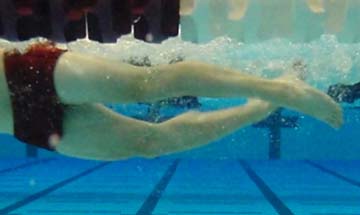
With a 2 beat kick, your bottom leg (leg closest to the bottom of the pool) kicks shortly after the arm begins its pull. So your right arm enters the water and right after it begins its pull, the right leg applies one swift kick. That one, powerful, well placed kick is all you need to begin rotating to the left side. If you have a 4 beat kick, that means that your bottom legs kicks to start the rotation and the top leg immediately follows and COUNTERS that kick, slowing or hindering the rotation. People with a 4 beat tend to struggle more with a good rotation as their kick isn’t helping as much as it should. The 6 beat kick allows for two kicks toward rotation, and one to counter, so you are netting out a solid rotation. Anything more than that and you are swimming from a shark in an all out sprint.
Trying to get a good visual of that kick? Think of kicking a soccer ball with your bottom leg. Swift deliberate and powerful. Of course the flexibility of your ankles come into play as well.

Now we all know that the quads are some pretty large muscles, and while they can generate some pretty powerful movements, they also burn up a serious amount of oxygen. So, if you are generating a lot of power and burning a ton of oxygen, but aren’t getting much benefit from it (propulsion) why wear yourself and your legs out? This, in my opinion, why the 2 beat kick is so important to learn if you are doing triathlons or swimming long distances.

Alright, so lets take a look at the two types of kick. First off, take a look at Michelle’s freestyle. She has a great stroke and has really improved over the last 2 seasons.  In the video, she is swimming a little faster than 1:20 per hundred yards and quite comfortable. Clearly no slouch. Pay attention to the kick.

 Now, take a look at a two beat kick. In this clip I am swimming about 1:12 per hundred yards.

The differences are pretty subtle between the two strokes top to bottom, but Michelle has a 4 beat and I have a 2 beat. Who looks like they’re spending more energy?

This goes back to another point I tend to talk about. A more efficient swim will not only make you a faster swimmer, but make you a faster cyclist because you are much fresher coming out of the water.

A lot to think about here, but hop in the pool and give it a try. So, at what level of a swimmer should you try to work on getting into a 2 beat kick?  I think you should learn it from the start. It seems like breaking the habit of the 4 beat kick is like quitting smoking, based on the swimmers I help.

Good Luck and let me know if I can help.

Posted in Swimming, Swimming Technique | Tagged , , , , , , | 5 Comments

Richard Quick Will Be Missed

Last night I heard that Richard Quick past away due to brain cancer. For those who don’t follow swimming, the name may not ring a bell right away. Some of the swimmers he coached you will recognize though. Names like Rowdy Gaines, Darra Torres, Summer Sanders, Jenny Thompson and Misty Hyman are just the tip of the iceburg. In short, he won 12 NCAA titles and was a 6 time Olympic coach. He will be remembered as one of the greatest in the sport of swimming. My thoughts and prayers go out to his family and friends.


You can read more about his accomplishments here.

Posted in Uncategorized | Tagged , | Leave a comment