Monthly Archives: March 2009

Reducing Drag

As a triathlete, I have read countless articles and lab tests about reducing drag. Swing by a high end bike shop and you can spend thousands of dollars to shave off a few minutes on the bike. For example, you can save 3-4 minutes if you switch to aerobars, an aero helmet will buy you about 30 seconds, and another couple of minutes if you switch to a deep dish front/disc wheel. Now all of this is based on tests at 30mph for 40 kilometers, so if you can’t go that fast for an hour (and I know you can’t so don’t try and tell me otherwise) the above mentioned time savings are diminished.

One of the areas of drag that isn’t discussed much, or at least not in this context, is in the water. If you climb on a bike and burn 100 calories, 95 of those calories are used to move forward and 5 calories are lost in fighting the wind, rolling resistance, chain friction, etc. On the other hand, if you jump in the water and burn 100 calories swimming, anywhere from 1 to 10 calories are used to move you forward and 90-99 calories are lost to fighting the resistance of the water. So we spend thousands of dollars to minimize the effects of that 5% on the bike, but it seems to me that we can get more bang for our buck by trying to minmize the 90% in the swim. Problem is, you can’t buy anything to fix bad form.

Swimming is very much like cycling in the sense that any adjustment in our position can potentially save us time. For instance, a better streamline through the water can take minutes off your time in even a sprint race, but to get a better streamline you need to be flexible. In my discussions and clinics  I put on I often demonstrate how good flexibility can overcome a host of  issues like streamlining. When I tell them that they need to stretch regularly in order to do this, I’m often looked at like I’m speaking Spanish. 

The great thing about reducing drag and swimming more effectively is that is will benefit you in a couple of ways. As an efficient swimmer, not only am I swimming faster, but I’m also using less energy doing it. I’ll use the Ironman distance as the example. Say I get out around 50 min, but I do it without spending much energy per stroke because I’ve reduced the drag. If a non swimmer gets out in 1:10, not only do I have a 20 min lead, but I’ve burned fewer calories in the water simply because it took me less time AND my effort level is lower to achieve those results, so I spent even less energy in the water. I am fresh on the bike and know I have a 20 min cushion. The poorer swimmer is tired out of the water and down 20 minutes.

Since 95% of your effort on a bike moves you forward and therefore very small gains are made in reducing drag, the same thing cannot be said on the bike or run.  Cycling and running don’t have the same technique factor. It’s more of a 1 to 1 relationship with cycling and running(or .95 to 1 to be more accurate). Put in X effort and you get X time. So the cyclist has 5 hours to make up the 20 minutes. Assuming he can average a full 1.5 mph faster, it will take him 100 miles to make up the time, but the effort level would be the same for both.  The swimming equation is more like X effort + X technique = X time. So the bad swimmer has to put in more effort to achieve a lesser result because of drag/technique. The good swimmer can lean on the good technique and ease off the effort to achieve the desired result.

So what’s the moral to this story? There’s alot of free speed in the water if you spend some time on the little things to reduce drag. It’s not as fun as buying a new cycling toy, but remember this: while wearing an aero helmet can save you up to 30 seconds during a 1 hour ride, making some key adjustments in the pool can save you upwards of 30 seconds per 100 yards. So in a sprint, you can gain 15 seconds on the bike, but over 2 minutes in the swim.

I’ll take the 2 minutes everytime.

Posted in Swimming, Swimming Technique, Training | Tagged | 1 Comment

Overcoming the Fear of Swimming in Open Water

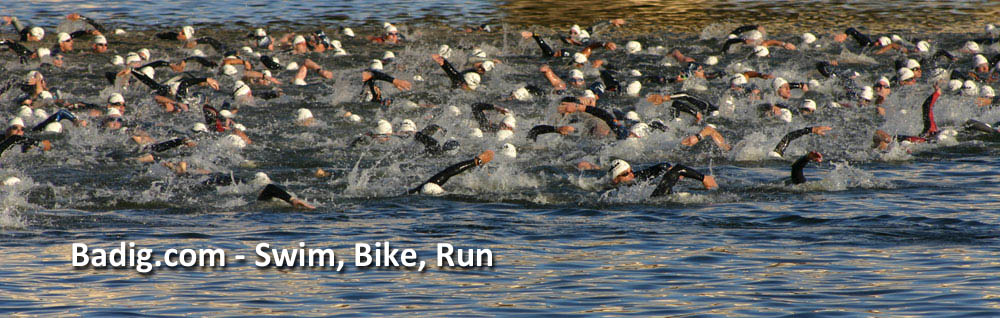
openswim3 Let’s face it, of the three sports that make up a triathlon, the swim is really the only one that people consider ‘scary’. And they have a  legitimate right to think that way. The water is often cloudy, so you can’t see where you’re going. The start is crowded and you get kicked, hit, and sometimes swum over by your competitors. Can you imagine a 5K run where you kicked and punched all the runners around you for the first 100 yards? Add all of this to the fact that if you stop swimming you can drown. It’s no wonder why I hear so many people tell me that they would love to do a triathlon but they’re too nervous about the swimming portion.


Many people commit to a triathlon and then proceed to have a melt down shortly after the start of the swim. I run an open water clinic every year in the weeks leading up to a big sprint race in the area and without exception there are a number of people who have an anxiety attack just 30 yards into our dry run of the course.

  Read More »

Posted in Open Water Swimming, Swimming, Swimming Technique | Tagged , , , , , , | 1 Comment

Breaking Down Mike’s Stroke

Not too long ago Mike contacted me from New York with a few questions regarding his swim technique after reading my swim articles.  It’s always easier to comment on something when you can see the stroke, so I asked for a video clip. I thought it might help others if I took Mike’s stroke and critiqued it here on the site. It should be noted that Mike has been swimming now for about 4 months now, which I find amazing since his stroke as a whole is pretty darn good. I should also mention that I am only commenting on some key areas, as fixing the bigger things will often correct the smaller things automatically. Read More »

Posted in Swimming, Swimming Technique | Tagged , , , , | Leave a comment

Ironman World Championships, Kona Hawaii

imhaAhh yes. The Ironman. The toughest one day event in world. It’s lure has grown to the point that has been inserted into everyday conversation. If someone endures in any facet of life, they are often referred to as an “Ironman”. Timex has made a fortune on their watch by the same name. It all started in a bar back in the late 70′s. An argument began over who the fittest athletes were. Naval Officer John Collins suggested settling the argument by combining the Wikiki Rough Water Swim with the Round the Island Bike Race. If they knocked 3 miles off of the ride it would put them at the start of the Honolulu Marathon. The Ironman was born.  After a couple of years the race grew too big for its urban location, so the event was moved to the big island.

The course is the stuff of legend. It’s a open water swim in the Pacific Ocean. The bike takes you north up the island across the lava fields and through some of the toughest winds anywhere, which have reached upwards of 60 mph and have blown people right off their bike. The run starts along the coast and then moves back out into the heat and isolation of the black lava fields. The suffering ends back where you started at Kailua Bay for the finish down Alii Drive. Read More »

Posted in The Bucket List | Tagged , , | 1 Comment