The Problem with Power

Power is hot. It’s the new it. And I’m the first to agree that it’s a great tool. One of the best. For those scratching their heads, I’m referring to bike training with power (or a power meter). It’s a great tool, as it measures the energy output that you’re putting out during your ride. I will be the first to tell you that using a powermeter in conjunction with a heart rate monitor is probably the most ideal training setup on the market today when you’re on your bike. But with all it’s pluses, it still has it’s issues.

Power is an output. Just like speed or pace, it’s a result of the effort, or stress, that you put your body through. And similar to all outputs, it’s absolute. In fact that’s one of the talking points that the uber powermeter crowd touts. A watt is a watt. I would agree. Most outputs are. A pace is a pace, a mph is a mph. BUT, and this is a big but, your body’s ability to produce that watt is variable. And therin lies rub #1.

A lot of the discussion out there is that a power meter is more accurate than a heart rate monitor, so just training via power  alone is a better way to go. I gotta say, that statement doesn’t really make a lot of sense to me. That’s like saying the fuel gage in your car is more accurate than the temperature gage. They measure 2 entirely different things. Powermeters measure the power that your body has generated. Heartrate measures the stress your body is under while you produce that power. So if you leave the heart rate monitor at home for your next ride or race and simply go by the goal wattage that you have calculated for the event, you may be setting yourself up for a tough day. This is because 250 watts in hour 1 in comfortable weather is much different that 250 watts in hour 5 in the heat. It’s these slow changes over time that make it so critical to have an eye on your body while you have the other on the power.

Another problem you run into is the need for constant testing if you want to do it right. Since a watt has no connection with effort of the body, your improvement will be tougher to recognize without constant testing. For instance, lets take our fictional athete Joe. He does a threshold test for power and comes up with a wattage of 100. So he builds a training plan around that wattage and follows it to the T.  After a couple weeks of training though, his body has adapted and improved. So now his effort level has dropped well below what it was intended to maintain the test goal power. Because of lower effort levels his improvement stagnates some. The next test shows that his power has increased to 150.  So somewhere along the way he should have increased the ride wattage to keep up with his improvement. Without testing though, it’d only be a guess. 

Now take Larry who trains wattage and heart rate, but does his threshold tests based on heart rate. So Larry finds that at his threshold heart rate of of 150 he is crankin out 100 watts as well. Larry follows his plan just as religiously, except Larry’s wattage increases througout the training cycle as he maintains the goal heart rates. The next time Larry tests he finds that his his threshold heart rate has increased to 152, but his wattage at that effort level is now 165. Larry’s rate of improvement is faster because he’s monitoring both the stress of the work and the output of that stress.

The other big problem with training exclusively with watts has less to do with the technology and more with the approach. If you look through the training practices, you’ll see that there are goal and average wattages that tested for. So Joe buys a powermeter, tests for his functional threshold power (ftp) and finds an average or goal power for any given distance. So far so good, but the next part is the problem. Once given the average power, Joe tries to stay at that average regardless of terrain. So he ends up riding  easier than normal up the hill and then harder than normal on the descent.  On the surface, not a big deal, but add in aerodynamics and wind resistance and the worm starts to turn. The air resistance on the climb is much different than the descent not to mention the gravitational resistance.  So while power is much more important on the climb, Joe eases up, and when aerodynamics are much more important on the descent, Joe pushes harder. Need an example? Where is the Tour de France won and lost? The mountains. An not just the mountains, but the climbs. If you have 2 riders exactly the same size, and both average 250 watts for a ride, they should have the same time, right? Wrong.

Take rider A, who does just as I mentioned earlier. His goal for average watts is 250, so he keeps that wattage across the entire ride. Up hill, downhill, flats, whatever. His effort is balanced and his ride seems strong. Well done.

Now take rider B, who rides the exact same course and averages the exact same wattage, but takes into account all aspects of the ride. On the climbs when he can get the most power bang for his buck, he pushes 350 watts instead of 250. While this is a bit more tiring, he also makes huge ground on rider A. With little air resistance climbing, all that added power translates directly into speed. Then, rider B only puts up 150 watts on the descent, and at times, even coasts. Why? because the air resistence is exponentially stiffer as speed increases, so with a focus on aerodynamics and rest, rider B only loses a small amount of time to rider A and is able to fully recover.

"The Look"

Now the real world example (although admittedly a bit extreme). Watch a mountain stage of the Tour de France. All the moves are made on the uphill because the power output most directly influences the pace. Once you’re dropped, it’s pretty much over. Sure, riders can make up some time on the downhill, but it’s incredibly small by comparision, even if the wattage is considerably greater than your compeition. You could even call it return on investment.  So while you kill it on the downhill and get a small return, your competition is banking that effort for the uphill, where they will get a huge return by comparison.

So if you get more bang for your buck generating more power on the uphill, how can you tell when more power is too much power for you to handle? That great big red thing between your boobies. Strap on a heart rate monitor my friend, and find out how much stress your putting on yourself.

Power on Wayne. Power on Garth.

Posted in Biking, Training | Tagged , , , , | 2 Comments

How Safe is Cycling?

Recently, with the help of some friends, I was able to find a route that I could use to ride my bike to work. Obviously, safety was my main concern. It’s something that cyclists and their families think about a great deal. I know that in our house, my wife always worries as I leave the house in the mornings for my rides. Honestly though, at times I worry a bit myself. I don’t want a recreational activity to end up as a life altering, or ending, event. So I thought I would do a little digging to see how safe our sport is. What I found was quite comforting.

In 2009, there were 630 cycling fatalities nationwide. Initially the number seems a bit large, but that breaks down to about 13 fatalities per state. Of course fate doesn’t yeild it’s sword evenly, so I would assume states like Texas and California are going to have a much greater percentage of those deaths than North Dakota or Wyoming. Still, given all the cycling in this country, 630 didn’t seem alarming. But here’s where it got interesting for me.

Bicycle fatality statistics are not reported for just those who ride competitively or as a form of exercise. It records all deaths on a bike. Of that 630 deaths, 28% of those people were drunk. Even more surpising to me was that 91% of fatalities happened when the rider wasn’t wearing a helmet. That means 53 people died last year on a bike while wearing a helmet, or roughly 1 per state per year. There were some other interesting statistics such as percentage that were riding against the flow of traffic and those within 25 feet of an intersection.

I watch enough politics to know that numbers can be resuffled to fit your agenda. (Ever heard the old saying, ” Theres 3 types of lies. Lies, Damn Lies, and Statistics”) Perfect example was an article that I read in looking up this stuff that stated that cycling was one of the most dangerous sports around. Why? The writer took similar statistics that I’ve used and calculated deaths per mile ridden. Since most people (including those who choose to ride drunk at 3 am) ride a very short distance, it skewed the numbers to fit his purpose. Maybe I’m doing the same thing. I don’t know.

Anyway, this is what I learned from my little exercise. If you ride with a helmet, with traffic, sober, during normal people hours (7% were killed between 3am and 6am) and obey the traffic laws (i.e. stopping running red lights). Then you have considerably lowered your chances of getting hit.

Now I’m quite aware that sometimes bad stuff just happens. I’ve seen friends get hit and been hit myself. There will always be jackasses who are allowed to get behind the wheel of a car, not to mention the true accidents that happen. But taking a few precautions will keep your risks quite low.

Oh, and I tried out the route and rode to work the other day. It went much better than expected, and was a great way to add 50 miles to my training.

Keep the rubber side down.

Posted in Biking, Training | Tagged | Leave a comment

The Importance of Flip Turns

There are a few endurance sports related websites that I haunt from time to time. In the various discussions there are a few topics that show up on a regular basis. Flipturns are one of them. It usually starts with someone asking about tips to learn or improve their turn. The general response from the hoards are”why bother? You don’t have to do flip turns in open water so it really doesn’t matter”. There will be a few experienced swimmers in the mix who try and stress the importance, but trying to educate an uniformed and unwilling mob is a losing battle. There is one thing that I have learned about flipturns over the years, and that is this: If you can you will; if you can’t you will make excuses. I’ve never met a swimmer who can do an effective turn and chooses not to. Good swimmers use a flipturn. This isn’t some groundbreaking revelation. I would bet that every single person on this planet who finishes an Ironman swim in 55 minutes or better does flipturns in training. 

So why is it met with such resistance? Beats me. The good cyclists all know how to ride in a pace line. No one says “don’t learn how to ride in a group because you don’t draft in a triathlon”. Riding in a group teaches handling skills, pace, and often can push you beyond what you would normally do by yourself in an effort to keep up with those faster. While the skill set learned by doing a flipturn varies a great deal from that of riding in a paceline, the indirect benefits of learning to flip are just as important. So let your guard down for a minute and let’s go over a few perks that come with an effective flipturn.

1. Uninterrupted swimming. I figure I would start with the most obvious benefit. For those who swim in an 25 yard pool (most of us) and do an open turn (meaning you put your hand on the wall to turn around), you are interrupting the pace and rhythm of your swim at least a couple times a minute. Better swimmers who have dialed in the open turn a little are also getting a little extra rest and an added breath.  Hey, wait a minute…you don’t get to grab a wall and take an extra breath every 25 yards in an open water swim! Why the heck are you doing it then? Because it’s easier.

Quick side story. Every year I do a swim clinic for a local sprint race here where I live for first timers or those unsure about open water swimming. We go through a number of things regarding anxiety, sighting positioning, etc. When it’s time to swim, without fail I have a few people who swim 30 to 40 yards, roll over on their back and paddle to the shore (see where this is going?). They almost always get out and tell me how they regularly swim lap after lap in the pool without a problem and they can’t figure out what happened. I will tell you that there are a number of things that go wrong in the first minute of a lake swim, but the lack of a wall to grab to get an extra breath is a large contributor to their problems.

By doing an effective turn, you eliminate breaktime every 25 and create a more continuous workout. It’s going to make you tired faster, but it will also make you faster faster.

2. Breath control. I don’t want to turn this into a long winded (get it? man I crack myself up) discussion on hypoxic training, but I will say this. Trying to simulate altitude training simply by holding your breath is ridiculous, but in swimming there is still a need (and some benefits and adaptations) to learn how to control your breathing while you swim. Swimming is one of the only sports that you don’t have free access to oxygen at all times. Because of this, you need to be able to manage and time your breathing to match your effort. Flip turns are a great way to get better at all of this. If you do, say, a race pace 500 in a workout you will notice that towards the end of the 500 that you have more and more trouble finishing your turns as the need for oxygen becomes overwhelming. Yet over time, your body will adapt by increasing lung capacity, alveolar number and pulmonary diffusing capacity making those turns easier. The nice carryover that you get is that you can manage your breathing in-between turns better because of this. So that desperate gasp for air late in a hard swim becomes lessened. Now apply this to open water. At the start, we have all been or will be hit, kicked or run over at that start and thereby disrupting our breathing. Same goes for wavy or rough conditions. Your ability to adapt easily and not get panicked or out of breath will allow you to maintain form and speed, even you missed some air.

3. Better Technique. In the swimming world, it’s referred to as “feel for the water”. I would also call it better awareness in the water. As I’m sure you’ve noticed by now, very small adjustments in swimming can lead to very large improvements. I mostly discuss the larger aspects of swimming here so as not to muddy the waters (get it? man I’m on a roll here. tip your waitress), but there are lots of smaller items that add up as well. Did you know some of the best swimmers glide with their hand at a 25 degree angle and not flat? You get the idea. So with flip turns, the motion of your hands, arms, head, torso, legs, etc will all effect what happens as you turn. Learning that awareness, and applying it to the rest of your swimming will give you tools you didn’t have before in your attempt to get better. The little things add up.

4. Pool Swim Triathlons – Obvious, but worth mentioning. As you can see in this clip of me flipping under a lane rope, if you can swim a snake in a pool and use turns, you can make some serious time on your competition.

5. And of course …Street Cred: Let’s face facts, if you are doing flip turns in your workout, your street cred goes up. You look like you know what you are doing. We’ve all seen (or in my case been) the guy who wore tennis shoes and a tshirt to his first club bike ride. Not a thing wrong with it, but you knew right away that this guy was new to the sport. Compare that to the day you saw the tshirt guy show up on a new rig and had cycling shoes and cycling clothes. Looked like he knew what the heck he was doing didn’t he?

There are other perks to learning how to do a flipturn, but really now, if you aren’t interested in seeing the light then there aren’t any examples I could give that are going to change your mind. And that’s ok. I am quite aware that there are many out there that deep down aren’t that interested in getting much better at swimming, which is perfectly fine. Sports are about having fun, not torture. Get out there and enjoy yourself. Plus, the less you want to do flipturns, the further down the road I will be before you climb out of the water. And I have no problem with that at all.

Happy flipping.

Posted in Swimming, Swimming Technique, Training | Tagged , , , , | 2 Comments

Ironman Texas

Below is the long, way too detailed version of Ironman Texas 2011. I write these more for myself than for others, as I try to note events/stats that will help me remember and correct for the next race. But some people enjoy reading. Let the record show that you were warned.

Got up about 4am after poor night’s sleep. Since I live less than 2 miles from transition, prerace was a snap. 3 hard boiled eggs and a small cup of coffee. Previously I have tried to stuff more food down my throat, but it seems to just make me uncomfortable. Mixed up all my race drinks (perpetum and pure sport) and headed over to transition. Being a local was a big help because we knew the good places to park that no one knew about. did my thing with the bags bottles and tires and started walking to the start with Amy.

Event warmup:

Because of the narrow boat ramp and the fact that they had to separate the wetsuits users from the non wetsuit users, they started letting people in the water around 6:40ish. I was sure to be right up front so I could get in and warm up some. Was able to swim easy for about 10-15 minutes before I had to go fight for positioning.

Swim

Since the water wasn’t wetsuit legal for any form of consideration other than being a finisher, there was a mix of wetsuit and non wetsuit swimmers. At first I didn’t really care because I didn’t think I would really be affected, but as the start got closer I noticed a number of wetsuits pushing their way to the front of the start. A quick glance at the equipment they were using told me they were about to get maimed when the gun when off. (Sounds a bit presumptuous I know, but just like seeing a cyclist in tennis shoes, it’s often easy to pick strong/weak swimmers out of a crowd based on their equipment choices). If they weren’t wearing the rubber courage, I guarantee they wouldn’t be in front elbowing me for space. Translate this through the entire field and I would say that this was probably a more congested/violent swim than it needed to be. I’m a big fan of the mass start, but if they’re going to allow 2 sets of rules, perhaps a two wave start would be safer.
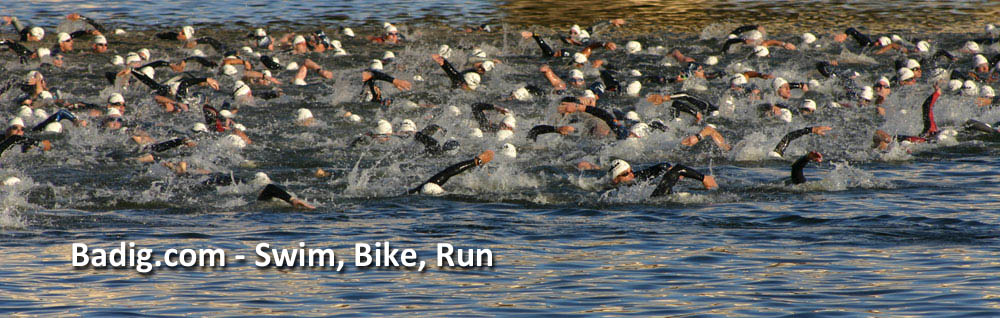
Anyway, the gun went off and I hit the gas for a good 20 seconds. I Looked both ways and saw I was leading so I immediately throttled back and worked to settle into my pace. Because of a little mishap working on my bike, breathing to the left was a bit of a challenge because of some lingering soreness/swelling. For this reason, I did very little breathing to the left, and I paid for it. What I didn’t notice was that the two people I was looking for were about 20 yards to my left and slowly passing me. When I finally noticed I tried to move over and catch some feet, but it was too late. Stupid tactical error. I ended up swimming about 25-35 yards behind them alone for about the first 1.8 miles, give or take. At that point I started feeling a little tired, which is something I never feel in the swim. I knew then that my fitness wasn’t nearly where it should have been. Work leading up the race was extremely busy, and swimming is the first workout I cut when I’m pinched for time. So now I had to pay for it. The 2 in front of me started really gapping and I just focused on staying smooth through the canal. The swim course by the way was really great. The last half mile swimming through the canal, there are people on both sides cheering you on. Very cool. Time: 52:24

What would I do differently?Train more, plain and simple. And don’t getted jacked in the jaw with your bike the week before the race.

T1

My MO in transition is to keep it simple. More stuff to do/think about means more things to screw up. So I got out, ran to my bag and then to the tent. Off came the Torque and on went the helmet and shoes. Passed one of the swimmers that finished in front of me and a pro male in transition. Time: 2:10

Bike:

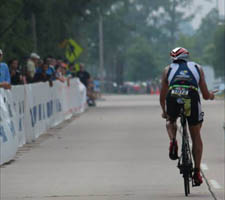
Hopped on the bike and passed a male pro in the first mile. Once he got adjusted though he took off and out of sight like I was just learning to ride a bike. Because of my limited time to train the bike and therefore relative weakness in this event, I expect to see stronger cyclists begin to pass me by about mile 5. I was riding a bit quicker than usual this time I guess. Not sure if it was more fitness, better set up or what, but mile 5 came and went and there was no one behind me. Couldn’t see anyone. Then came mile 10, then 15, then 20. Still no one. What the? The fastest swimmer was off the front, so I’m sitting second overall and rolling through mile 25. Then 30. Then 35. At this point there were 2 athletes rolling up on me. Ok, here comes the train of cyclists. As they passed I realized that it was a pro male with a pro female drafting him (blatant I might add). So I was still in 2nd. It wasn’t until right before mile 40 that the first amatuer passed me. I was surprised it took so long, but I was riding right at a 5 hr pace so I guess in hindsight it makes sense that it would take a little longer for everyone to catch up. A few miles later the second guy came by, and as he did he asked, “Do you want to take turns taking 2 minute pulls?” I looked at him like he just offered to lick my toes. He then quickly added “legal pulls”. Whatever dude. I might have a slow bike time, but it’s legit. Slowly the cyclists then began coming, most all clean, but a few wheel suckers. Somewhere around mile 50 we came into an area that had just received a heavy rain, and the roads were soaked. I train this stretch every weekend and knew that the tar/oil with the water was going to make this section extremely slick, so I slowed way down. (I later saw a few riders with some healthy road rash and torn clothes, so my assumptions seemed to be confirmed.) I crossed the halfway point around 2:34ish and in 7th overall. I kept a keen eye on my heart rate the entire way and made sure the I kept the legs well in reserve. Even on the few hills I kept the effort so that I had 2 gears left in me. In terms of nutrition, I was drinking 1 bottle every hour, a saltstick tablet about every 30-45 minutes, and drinking the perpetum bottle as needed. 6 months ago in Ironman Cozumel I drank 1 bottle every 30 minutes and ended the ride feeling bloated and struggled with stomach issues on the run a bit because of it. This seemed at first to work much better, especially because the first few hours of the bike were under an overcast sky. The clouds actually made me rethink the hydration a little as at times it felt downright comfortable outside. That turned out to be a bit of a mistake as I would find out later.
Coming back to The Woodlands there was a bit of a headwind, but nothing to complain about. I went through a few rough patches where the back/neck would get tight, but otherwise a pretty consistent ride. Felt pretty good once I got back in the Woodlands, and the crowds on every corner certainly helped. Hear rate consistant throughout, with about a 5 beat rise in the last 10 miles or so. That was a tell…

Time: 5:15

What would I do differently? Drink a more balanced mix of water and Perform. I drank about 90% Perform, and what I thought was a bloating feeling was actually a mild case of sour stomach. Next time I will probably alternate bottles so I can help fix the hydration challenge.

T2

Rolled in, handed off the bike and ran to the tent. When I sat down I thought to myself, “take your time and get everything right for this brutal run”. Was a little surprised that it was still a 3 minute transition. I thought I sat there for a while. oh well. Time: 3:00

Run

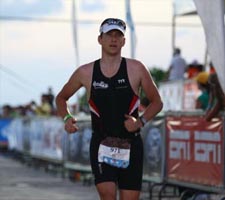
The heat and humidity hit me like a wall. This was my 5th Ironman, and each one I have done has been in temperatures above 90 degrees. Having said that, this run felt the hottest. I knew immediately I was in trouble. I kept slowing down and the heart rate kept climbing (even though RPE felt the same). About a half mile in, my breathing started feeling shallow, like an asthma attack was coming. It was at this point that my mind started debating whether I could finish. I immediately kissed Kona goodbye. This was my hometown race and I wasn’t about to drop out in my backyard. As I ran up to the mile 1 aid station, I kept telling myself, “this is the unplanned problem for this race, just figure it out”. Got to mile 1 in 7:40 and hit the port-a-can. Immediatley figured out problem #1. I’m dehydrated. So I stopped at the aid station and started taking in A LOT of fluids. Jogged very easy to the next aid station and repeated the hydration. Struggled this way through the 4th aid station. Then slowly I was able to run at a steady pace again. Things started turning, even if slowly. Ran through a couple of aid stations and then started fighting the overheating. So I dedcided that since a Kona slot was out, I would walk through the aid stations and get as much ice on me as I could find a spot for. Chest, back, groin, and held a handful in each hand. This run was frickin hot! I have never seen so many pro’s walking. I actually passed a few on the run (ok, ok, they were a lap ahead of me but I still passed them technically!) Somewhere around mile 13 I got an update from a friend. He told me that the last update showed that I was 9th in my AG. So I thought back to where the last checkpoint would have been that was already on the internet and it was a good chunk back (maybe mile 8 or 9?), but I did start noticing that I wasn’t really getting passed much out here. I really couldn’t believe it. I was having a horrible run and running at what felt like a snails pace. So I guess everyone was suffering too, and I’m still in this race. Of course heat management was priority, but now there was a little more urgency in my step. Started the 3rd lap and life started getting confusing. I had to try and figure out if the person that was passing me was on their first, second or final lap. (On a side note, the crowds on the run were fantastic, especially on the waterway. Huge props to the director for designing the run course.). When I got to the turnaround (at Landry’s) I forced myself to up the pace as I noticed I was closing in on a competitor in my AG. Made the turn into Market street and soaked it up best I could. Great finish area set up by the way! Time: 4:01

What would I do differently? Start the run well hydrated.

My warm down amounted to zero. Almost passed out about 10 minutes after the race while talking to friends and family, so I spent a few minutes with the docs, drank some chicken broth and then headed for home. On the way out I heard from a couple of people that I finished 11th. The prerace predictions were that 11 slots would go to my age group (the largest age group starting). So it was just a matter of waiting until morning to see if it would be official. Went home, had friends come over, drank beer and ate pizza. The next morning I got my confirmation that it was indeed 11 slots and got my golden ticket to Kona! This will be my 3rd trip there, and I haven’t had the best history in Kona (more on that another time) , so my goal is to actually experience the legendary Kona finish, even though I finished both times.

Of course if I trained for the swim a bit more I might be able to…well….we’ll have to wait and see ;)

**Photo’s taken off of Facebook via firends who took the pictures. I would like to thank them and If any of the pictures need to be removed, just let me know.***
Posted in Biking, Running, Swimming | 2 Comments