Category Archives: Training

Ironman Texas Practice Swim, April 28th 2012

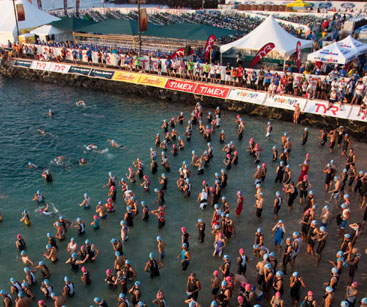
It’s that time of year again. Time to get dialed in for Ironman Texas. You’ve done the long rides, ran the long runs, and now it’s time to go for a long swim in Lake Woodlands. A 1.2 mile loop will be marked with the full support of lifeguards and boats. They will also have vendors and a bag drop to leave your stuff while you swim. Starts at 7:30am and be sure to get there on time, as they will stop letting athletes in the water at 8:30am. Please note that the entire Ironman Texas course will not be available. Swimming up the waterway is a big no-no before raceday. After the Ironman course closes, they will move the buoys and set up the CB&I practice swim course. This will be a 500 meter triangle for those competing in the CB&I Triathlon on May 5th.

Here’s the flyer:

http://www.thewoodlandstownship-tx.gov/DocumentCenter/Home/View/2790

Worried about your first Ironman swim or the  CB&I Triathlon swim? Then sign up for the clinic I’m putting that morning. We’ll go over the course, what to watch for, what to watch out for, tactics, worries, you name it. Bring your questions and I’ll be happy to answer.

You can sign up by calling 281-210-3950 and ask for TJ Fry’s swim clinic.

See you out there.

Also posted in Open Water Swimming, Swimming | Tagged , , | Leave a comment

The Rules To Being a Triathlete

As I stumble around the internet from time to time I come across a variety of interesting sites. The other day, one in particular caught my eye that posted the rules of their sport. Now, this isn’t your run of the mill rules, like Section 3; Article 2: Contestant shall remain behind the foul line..blah blah blah, but rather rules to live by. Rules that will keep you in good graces with the rest of the tribe. So after a couple of moments of contemplation, I thought that some rules for us tri-geeks were in order. So here we go….

The Rules:

#1. Not everyone thinks what you do is awesome. Most think you’re a bit nuts, and they’re right. Remember that at your next cocktail party.

#2. No race jerseys of races you haven’t raced in, especially if the distance is longer than you’ve been. T-shirts are exempt. If you roll up in an Ironman France jersey, be prepared to explain how you handled the Cole de I’Ecre.

#3. Only refer to courses/segments/people by their nicknames. Highway 19 is unacceptable. It’s called the Queen K, and Crowie owned it. And Macca before him. Don’t let this happen again. Pay ‘N Save Hill. Look it up.

#4. Training in rough conditions makes you tough. A little rain or heat won’t make you melt, buttercup.

#5. A reality check should be performed once per year. MIT is not going to test the effectiveness of brick workouts. The rolling resistance “expert” uses a 100 pound sac in his garage for testing. Not all wind tunnels can even record data at the slow speeds we ride. Not everything that glitters is gold.

#6. Gadgets are strongly encouraged. An old pair of shorts and some Keds are not our gig. You absolutely need every item that is out there. Afterall, we invented aerobars. If we stop with the gadgets, who the hell would cyclists copy?

#7. Feelings are for Oprah, use your data. If you own a heart rate monitor and/or a powermeter, yet train just by RPE, then you either don’t know how to use it or you’re embarrassed by what it’s telling you.

#8. If you’ve raced the distance, it counts. If you’ve trained the distance, it doesn’t.  Nailing a training day is one thing, nailing a racing day is quite another. Please don’t confuse the two. Ironman/marathon/etc. only counts if you are in there mixing it up. I’m the heavyweight champion of the world if we don’t have to actually compete.

#9. The number of logos allowed on a race kit are equal to that of NASCAR. In other words, go nuts. Only Wimbledon and the ITU restrict logos to the point of communism.

#10. Ironman tattoos are perfectly acceptable. You just finished one of the toughest days of your life. A bit of ink is just fine. Don’t let douche bags rain on your accomplishment.

#11. No buckets. It’s doesn’t matter how well thought out your transition is, don’t bring a bucket unless you plan to paint parking lines on the concrete or are going fishing after the race.

#12. Shave. You’re representing a group of people generally regarded as some of the fittest in the world. It’s a hot, sweaty, sometimes muddy sport, that keeps clothes to a minimum. Hanging out all day with gorilla legs and a hairy back does not make you a good steward of the sport. Clean it up.

#13. Learn who the pros are. In this sport everyone likes to think they’re the next big deal. Do yourself a favor and learn the names of those who actually make a living at being a badass.

#14. Support the sponsors. They pay money so you can have a great time. Don’t spend 45 minutes picking their brain and then head to the ‘net so you can save 3 bucks. That will get you flogged.

#15. Exaggeration of training is perfectly fine. Just keep in mind that Rule #39 is still in effect at all times.

#16. Drinking and triathlon are first cousins. Embrace your first cousin. There’s a reason beer is offered at 9 am at the race. Because we love it. Science has actually shown that a buzz and runner’s high is very similar, and endurance athletes drink more than your average bear.

#17. It’s a transition area, not your hotel room. Spreading out all your stuff for transition beyond 1 small towel is not acceptable. 1 bag limit.

#18. White race kits are only allowed if you know your body well. Really well. If you’ve ever worried about poo leg on a long run, then white is not for you. Ladies, if you are expecting a visit from your “Aunt Flow” then white is not for you. I don’t think I need to say anymore.

#19. Qualifying for Kona and your local “wellness” or “anti aging” clinic do not go together. If by some coincidence you decide your wanker doesn’t work right the exact same time you’re trying to get to Kona, stop everything and look for a new sport. Getting HGH, Testosterone and EPO shots in the name of ‘aging’ or wiener health won’t fly here. There are sports where cheating seem to be acceptable like here and here, so try those sports. This isn’t one of em.

#20. This sport has a history, learn some it. If you don’t know who the Big Four are, unfamiliar with the ’82 Moss Crawl, or think the Ironwar has something to do with the Industrial Age, then you got some reading to do.

#21. No “trunks” in the pool. Look, we get it that you’re a little self conscious wearing a skin tight swimsuit. Get over it. I promise you that you will get 10X more comments trying to swim laps in basketball shorts than you will a jammer.

#22. It’s OK to hate swimming, but you still have to do it. It’s not OK to use your wetsuit as a life preserver. Learn to swim. If you don’t there’s a sport called duathlon just waiting for you.

#23. Learn to circle swim. You really don’t need the whole lane to yourself.  Stay to the right.

#24. Complaining about the water makes you look like a sissy. This is a tough sport. The distances are tough, the conditions are tough and the people are tough. Whining that the water isn’t as clear as your last trip to Grand Cayman isn’t winning you any cool points there Nancy.

#25. Learn Flipturns. You can pick the person out racing in high-tops right away. You get the idea.

#26. Obey the law – Nothing gives us a worse reputation than someone blowing through a red light like he’s above it all. The law applies to vehicles. You’re on a vehicle. Don’t be a douche. Obey the law.

#27. Don’t ride with headphones. Save the Rocky Soundtrack for your run. Your ears are needed to help keep you alive on the bike. Plus, depending on your state, it’s illegal. See Rule #26

#28. Support yourself. Others should not be obligated to babysit you on your ride. Flat tires should not take a village to fix.

#29. No aero helmets in training. While you might ride a whopping .2 mph faster, you will look like an absolute dork.

#30. Save the race wheels for the race. Yes, the bike does look cooler with $2,000 wheels, but your wallet will be thinner when a pot hole or rock crack that carbon. Leave some sizzle for the race.

#31. Learn to ride in a group.  Wobbling down the road being afraid of anything around you is no way to go through life.

#32. Hold your line. Erratic movements in a group ride will take everyone out. Tighten it up.

#33. Don’t make accordions. Taking a turn up front is expected and appreciated, but not if you floor it the moment you take the reins, The guy 20 people back is going to get dropped by moves like that. Accelerate slowly so everyone can play.

#34. No shorts over your cycling shorts. Sister to Rule #21. Dress like you know what you’re doing.

#35. Learn to pee on yourself.  You’ll spend $5,000 dollars to shave 55 seconds but won’t pee down your leg to save 3 minutes?

#36. The engine always trumps the rig. Always.

#37. Be on time, but don’t leave early. If the group ride or run is scheduled for 7 am, courtesy allows for 5 minutes. That means that sometime between 7 and 7:05 the wheels start rolling. If you roll up in your car at 7am and think everyone should wait for you to assemble your bike and pump up your tires, think again. Likewise, convincing the group to leave at 6:54 because you have a t-ball game is just bad form.

#38. No tan-lines allowed. This is not cycling. A farmer’s tan doesn’t make you look cool in anyway. The only exception is cycling short lines. Those are permitted, but need to be laser sharp.

#39. If you decide to talk the talk, be prepared to walk the walk. See also Rule #15. If you claim 3 hours at 300 watts, you’ll be expected to prove it.

#40. Crawling is an acceptable mode of transportation. It’s not pretty, but it gets the job done, and this sport is about getting the job done.


I noticed that I’m violating 4 rules currently. Guess I better get to work…

If I missed one let me know.


Also posted in Uncategorized | Tagged , , , , , | Leave a comment

The Red Headed, Step Brick

If you’re new to this sport, you will soon hear the term “brick” if you haven’t already. If you’ve been doing this sport for a while you probably hear it on a regular basis. The term “brick” refers to the training of two sports sports back to back without any rest. The term was created back in the late 80′s or early 90′s, when a pro triathlete and his training buddy (who would become the executive director of USA Triathlon) would do this type of training, and at the end, make a habit of quoting a Pink Floyd song. “Well, knocked that workout out. Another brick in the wall”. Over time that phrase stuck to that particular workout and became known as simply, “the brick”.  Most often people train on the bike and then immediately follow it with a run, in hopes of some race day simulation for the body. For some, bricks are a regular part of the workout diet.  For others, they skip them all together. Most of us fall somewhere in between.

For those who are regulars to the workout, they will argue that it helps your body adjust to the next sport quicker and teaches you to (in the case of the bike-run brick) run strong on tired legs. While we could discuss the virtues of the bike run brick, I’m going to save those, if any, for another day. What I did want to hit on was what I think of as the more important of the two bricks. The swim to bike brick.

On the bike to run brick, your cycling muscles are fully engorged in blood. Get off the bike to run and your legs will feel like lead. Partly because fatigue is setting in, but partly because the blood is sitting in some of the wrong muscles. For most it takes just a few minutes for the blood to shift an inch or two to the correct muscles before you feel like you have your running legs back. The fitter you are, the more blood vessels you have, the faster you get the blood moved over to those neighboring areas.

The swim to bike, however, is an entirely different equation. First of all, instead of using the same or neighboring muscles, the muscles you use for the swim are at the opposite end of your body. Back, shoulders and arms are all quite a distance from your calves and quads. So the travel time is considerably longer. Next problem is that you go from horizontal (swimming) to vertical (running to your bike and then biking). You also move from a zero gravity environment in the water, to gravity in all its glory. This creates adjustments that your body will need to make, not just with the muscles, but the organs as well.

These differences present some much different problems. First off is just standing up. With all the blood either in your shoulders/arms and balanced evenly in your organs for a weightless environment, you are going to feel horrible in about 10 seconds. Headrushes, dead feeling legs, and a heart rate that is going through the roof are all part of the fun. You will often see a very large number of people walking from the water to the transition area on race day for this very reason. Unfortunately it doesn’t end there. When you climb on your bike there is a high probability that your body is still working hard to reallocate it’s resources. I’ve found that it takes me as long as 20 minutes to get fully adjusted in an Ironman. Others mileage will vary based on how hard you pushed the swim, race distance, swim ability, etc., but you get the idea. Where a bike/run run lasts about 3 minutes to fully adjust to, the swim to bike acclimation takes a much longer time.

So why don’t many people practice this transition? Two big reasons. First is logistics. It can be hard to find a body of water that allows easy and quick access to the roads you ride. Short of a lake or outdoor pool that meets the critera, an easy fix could be your fitness center. Go get a really hard swim in. Hustle through the locker room and climb on a trainer just as fast as you can and then gun it. It’s not perfect, but it can help. Second is that water is involved, and triathletes as a population just don’t like to swim. So anything that includes water will more often than not be put to towards the bottom on the list of priorities.

Do yourself a favor and try and work one of these types of workouts in just once this summer. See if it helps, ’cause the last thing you want in your next race is to be still sucking wind 30 minutes into the bike ride. Happy Training.

Also posted in Biking, Swimming | Tagged , , | Leave a comment

The Problem with Power

Power is hot. It’s the new it. And I’m the first to agree that it’s a great tool. One of the best. For those scratching their heads, I’m referring to bike training with power (or a power meter). It’s a great tool, as it measures the energy output that you’re putting out during your ride. I will be the first to tell you that using a powermeter in conjunction with a heart rate monitor is probably the most ideal training setup on the market today when you’re on your bike. But with all it’s pluses, it still has it’s issues.

Power is an output. Just like speed or pace, it’s a result of the effort, or stress, that you put your body through. And similar to all outputs, it’s absolute. In fact that’s one of the talking points that the uber powermeter crowd touts. A watt is a watt. I would agree. Most outputs are. A pace is a pace, a mph is a mph. BUT, and this is a big but, your body’s ability to produce that watt is variable. And therin lies rub #1.

A lot of the discussion out there is that a power meter is more accurate than a heart rate monitor, so just training via power  alone is a better way to go. I gotta say, that statement doesn’t really make a lot of sense to me. That’s like saying the fuel gage in your car is more accurate than the temperature gage. They measure 2 entirely different things. Powermeters measure the power that your body has generated. Heartrate measures the stress your body is under while you produce that power. So if you leave the heart rate monitor at home for your next ride or race and simply go by the goal wattage that you have calculated for the event, you may be setting yourself up for a tough day. This is because 250 watts in hour 1 in comfortable weather is much different that 250 watts in hour 5 in the heat. It’s these slow changes over time that make it so critical to have an eye on your body while you have the other on the power.

Another problem you run into is the need for constant testing if you want to do it right. Since a watt has no connection with effort of the body, your improvement will be tougher to recognize without constant testing. For instance, lets take our fictional athete Joe. He does a threshold test for power and comes up with a wattage of 100. So he builds a training plan around that wattage and follows it to the T.  After a couple weeks of training though, his body has adapted and improved. So now his effort level has dropped well below what it was intended to maintain the test goal power. Because of lower effort levels his improvement stagnates some. The next test shows that his power has increased to 150.  So somewhere along the way he should have increased the ride wattage to keep up with his improvement. Without testing though, it’d only be a guess. 

Now take Larry who trains wattage and heart rate, but does his threshold tests based on heart rate. So Larry finds that at his threshold heart rate of of 150 he is crankin out 100 watts as well. Larry follows his plan just as religiously, except Larry’s wattage increases througout the training cycle as he maintains the goal heart rates. The next time Larry tests he finds that his his threshold heart rate has increased to 152, but his wattage at that effort level is now 165. Larry’s rate of improvement is faster because he’s monitoring both the stress of the work and the output of that stress.

The other big problem with training exclusively with watts has less to do with the technology and more with the approach. If you look through the training practices, you’ll see that there are goal and average wattages that tested for. So Joe buys a powermeter, tests for his functional threshold power (ftp) and finds an average or goal power for any given distance. So far so good, but the next part is the problem. Once given the average power, Joe tries to stay at that average regardless of terrain. So he ends up riding  easier than normal up the hill and then harder than normal on the descent.  On the surface, not a big deal, but add in aerodynamics and wind resistance and the worm starts to turn. The air resistance on the climb is much different than the descent not to mention the gravitational resistance.  So while power is much more important on the climb, Joe eases up, and when aerodynamics are much more important on the descent, Joe pushes harder. Need an example? Where is the Tour de France won and lost? The mountains. An not just the mountains, but the climbs. If you have 2 riders exactly the same size, and both average 250 watts for a ride, they should have the same time, right? Wrong.

Take rider A, who does just as I mentioned earlier. His goal for average watts is 250, so he keeps that wattage across the entire ride. Up hill, downhill, flats, whatever. His effort is balanced and his ride seems strong. Well done.

Now take rider B, who rides the exact same course and averages the exact same wattage, but takes into account all aspects of the ride. On the climbs when he can get the most power bang for his buck, he pushes 350 watts instead of 250. While this is a bit more tiring, he also makes huge ground on rider A. With little air resistance climbing, all that added power translates directly into speed. Then, rider B only puts up 150 watts on the descent, and at times, even coasts. Why? because the air resistence is exponentially stiffer as speed increases, so with a focus on aerodynamics and rest, rider B only loses a small amount of time to rider A and is able to fully recover.

"The Look"

Now the real world example (although admittedly a bit extreme). Watch a mountain stage of the Tour de France. All the moves are made on the uphill because the power output most directly influences the pace. Once you’re dropped, it’s pretty much over. Sure, riders can make up some time on the downhill, but it’s incredibly small by comparision, even if the wattage is considerably greater than your compeition. You could even call it return on investment.  So while you kill it on the downhill and get a small return, your competition is banking that effort for the uphill, where they will get a huge return by comparison.

So if you get more bang for your buck generating more power on the uphill, how can you tell when more power is too much power for you to handle? That great big red thing between your boobies. Strap on a heart rate monitor my friend, and find out how much stress your putting on yourself.

Power on Wayne. Power on Garth.

Also posted in Biking | Tagged , , , , | 2 Comments